Knowledge Hub
From BMI to BCA: Why Body Composition Is Becoming the New Wellness Currency

What will this article cover –
- Why BMI fails to reflect true metabolic health
- How body composition explains risk beyond weight
- What body composition analysis measures
- Technology options and why BIA is practical for routine care
- Clinical use across diseases and prevention - Market growth and India opportunity in preventive health
Body Mass Index (BMI) has long served as a dominant tool for obesity and metabolic risk. However, its core limitation is now well recognised: BMI reflects body weight relative to height but provides no information on fat mass, lean mass, fat distribution, or hydration status. As a result, individuals with a “normal” BMI may carry excess visceral fat and metabolic risk, while others with a high BMI may have preserved muscle mass and relatively lower risk. This disconnect has accelerated interest in body composition analysis (BCA) as a more clinically meaningful alternative to BMI alone (Bennett, 2025)

Why BMI Is No Longer Enough
BMI does not differentiate between adipose tissue and skeletal muscle, nor does it capture visceral adiposity, which plays a central role in cardiometabolic disease. Multiple studies have shown that visceral fat and body fat distribution correlate more strongly with insulin resistance, dyslipidaemia, and cardiovascular risk than BMI alone. Evidence from population studies confirms that individuals with similar BMI values can have markedly different metabolic risk profiles depending on visceral fat burden and lean mass (Mohammad et al., 2023).
Obesity is also currently defined using Body Mass Index, with a BMI of ≥30 kg/m² globally and ≥27.5 kg/m² for Asian populations serving as standard cut-offs. Integrating BCA into guidelines would enable phenotype-based obesity classification and align care with precision prevention, and improve clinical decision-making beyond weight alone.

What Body Composition Analysis Brings to the Table
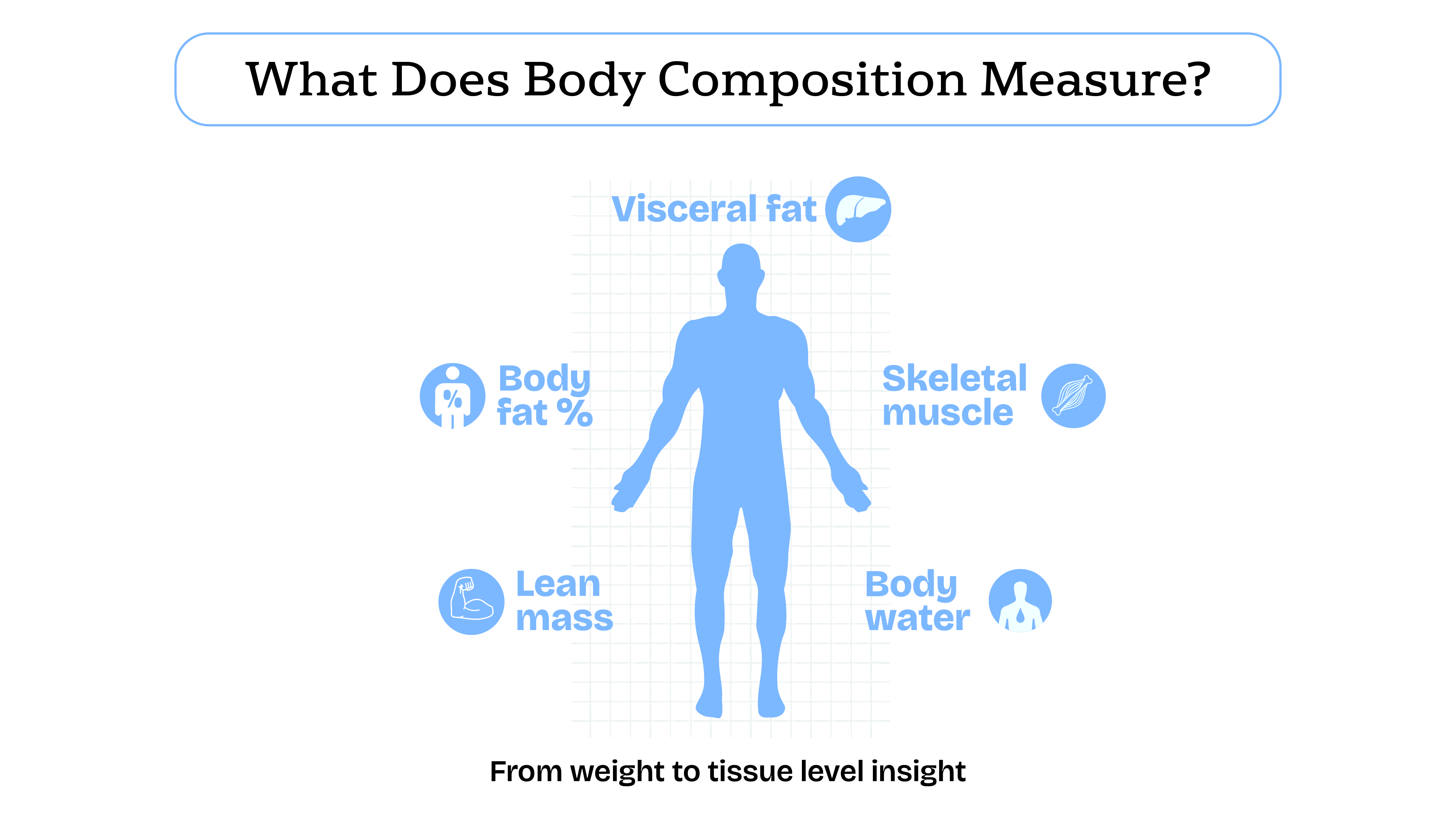
Body composition analysis extends beyond weight and height to quantify total body fat percentage, visceral adipose tissue, lean and skeletal muscle mass, and body water compartments. A comprehensive narrative review highlights that these parameters are clinically relevant across obesity, cardiometabolic disease, sarcopenia, oncology, and critical illness, where changes in lean mass are closely linked to outcomes (Bennett, 2025).
By enabling direct assessment of tissue composition, BCA shifts health evaluation from population-level averages to individualised metabolic phenotyping, a core principle of precision medicine.
Body Composition as a “Wellness Currency”
As healthcare systems increasingly prioritise prevention over treatment, body composition metrics are emerging as a new “wellness currency.” Unlike BMI, which is static and insensitive to compositional change, body composition allows individuals and clinicians to track meaningful improvements in fat reduction, muscle preservation, and metabolic health. In corporate wellness programs and preventive health screening, this approach improves engagement by focusing on quality of weight change rather than weight alone (Bennett, 2025).
Technology Enablers and Clinical Trade-offs Several technologies are used to assess body composition, each with distinct clinical trade-offs. CT and MRI provide highly precise anatomical measurement of fat and muscle distribution but are costly and impractical for routine use. Dual-energy X-ray absorptiometry (DXA) is widely used as a reference method for estimating fat and lean mass but involves radiation exposure and limited accessibility. Bioelectrical impedance analysis (BIA) has emerged as the most scalable option, enabling rapid, non-invasive, and repeatable assessments. While BIA accuracy is influenced by hydration status, recent food intake, and device-specific algorithms, comparative studies show meaningful agreement between BIA and DXA for population-level risk assessment. This supports BIA’s role in screening and longitudinal monitoring, with DXA reserved for reference assessment and CT/MRI for complex diagnostic or research settings (Diabetes, Obesity and Metabolism, 2026; Ishfaq et al., 2024).
As healthcare systems increasingly prioritise prevention over treatment, body composition metrics are emerging as a new “wellness currency.” Unlike BMI, which is static and insensitive to compositional change, body composition allows individuals and clinicians to track meaningful improvements in fat reduction, muscle preservation, and metabolic health. In corporate wellness programs and preventive health screening, this approach improves engagement by focusing on quality of weight change rather than weight alone (Bennett, 2025).
Technology Enablers and Clinical Trade-offs Several technologies are used to assess body composition, each with distinct clinical trade-offs. CT and MRI provide highly precise anatomical measurement of fat and muscle distribution but are costly and impractical for routine use. Dual-energy X-ray absorptiometry (DXA) is widely used as a reference method for estimating fat and lean mass but involves radiation exposure and limited accessibility. Bioelectrical impedance analysis (BIA) has emerged as the most scalable option, enabling rapid, non-invasive, and repeatable assessments. While BIA accuracy is influenced by hydration status, recent food intake, and device-specific algorithms, comparative studies show meaningful agreement between BIA and DXA for population-level risk assessment. This supports BIA’s role in screening and longitudinal monitoring, with DXA reserved for reference assessment and CT/MRI for complex diagnostic or research settings (Diabetes, Obesity and Metabolism, 2026; Ishfaq et al., 2024).

Disease-Centric Applications
Body composition analysis has demonstrated utility across multiple disease domains. Visceral fat measured by DXA or estimated by BIA shows strong associations with cardiometabolic risk independent of BMI (Mohammad et al., 2023).
In type 2 diabetes, visceral adiposity improves risk stratification beyond traditional anthropometric indices. In aging populations, loss of skeletal muscle mass predicts frailty, disability, and mortality. In critical illness and oncology, longitudinal lean mass changes correlate with prognosis and recovery (Bennett, 2025). These disease-specific applications underscore why BCA is more actionable than BMI-based categorisation.
In type 2 diabetes, visceral adiposity improves risk stratification beyond traditional anthropometric indices. In aging populations, loss of skeletal muscle mass predicts frailty, disability, and mortality. In critical illness and oncology, longitudinal lean mass changes correlate with prognosis and recovery (Bennett, 2025). These disease-specific applications underscore why BCA is more actionable than BMI-based categorisation.

India Market: Size, Growth & Momentum
The global body composition analyzers market was valued at approximately USD 714 million in 2024 and is projected to reach about USD 1.26 billion by 2033, driven by rising chronic disease prevalence and preventive health adoption (Grand View Research, 2024).
India represents a growing segment of this market, supported by increasing corporate wellness initiatives, preventive health screening, and fitness adoption. India-specific forecasts from the same source project sustained growth through 2033 (Grand View Research – India Outlook).

Risks and the Need for Clinical Oversight
As body composition technologies become more accessible, clinical oversight is critical. Hydration variability, inconsistent testing protocols, and algorithmic differences across devices can lead to misinterpretation if results are viewed in isolation. Expert reviews emphasise the importance of contextual interpretation and standardised measurement conditions to avoid inappropriate clinical conclusions (Bennett, 2025).
Future Outlook
The role of body composition analysis is expected to expand further as predictive analytics and AI integrate with longitudinal metabolic data, and as decentralised technologies reduce barriers to routine assessment. With increasing emphasis on precision prevention, body composition is likely to transition from an adjunct metric to a foundational component of preventive healthcare strategies.
Future Outlook
The role of body composition analysis is expected to expand further as predictive analytics and AI integrate with longitudinal metabolic data, and as decentralised technologies reduce barriers to routine assessment. With increasing emphasis on precision prevention, body composition is likely to transition from an adjunct metric to a foundational component of preventive healthcare strategies.