India Records Major Health Gains in 2025 Across Primary Care
India Records Major Health Gains in 2025 Across Primary Care
India’s public healthcare system registered significant progress in 2025, with major gains across primary healthcare delivery, disease elimination programmes, digital health infrastructure, and maternal-child health outcomes, according to the Ministry of Health & Family Welfare (MoHFW).
Expanded Primary Healthcare Through Ayushman Arogya Mandirs
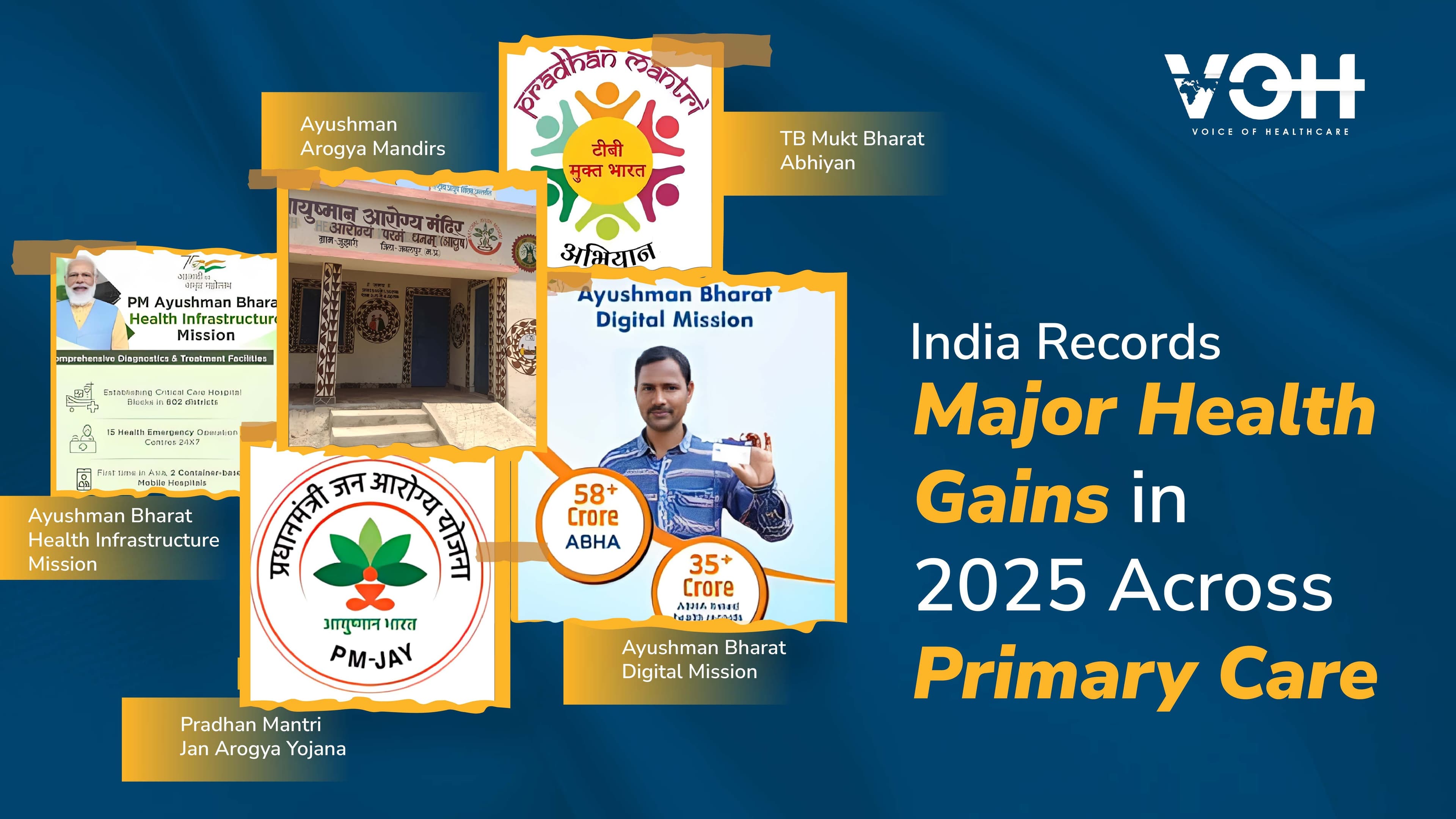
At the core of these achievements is Ayushman Bharat, which continues to anchor the country’s universal health coverage strategy. As of November 30, 2025, over 1.81 lakh Ayushman Arogya Mandirs are operational nationwide, delivering comprehensive primary healthcare services, including screening for non-communicable diseases, mental health support, geriatric care, and teleconsultation. These centres have collectively recorded a footfall of nearly 495 crore visits, alongside 41.9 crore teleconsultations.
PM‑JAY: World’s Largest Public Health Insurance Scheme
Under the Ayushman Bharat–Pradhan Mantri Jan Arogya Yojana (AB PM-JAY), India has extended health insurance coverage of ₹5 lakh per family per year to 12 crore families, making it the world’s largest publicly funded health assurance scheme. By December 2025, more than 42.48 crore Ayushman cards had been created, enabling 10.98 crore hospital admissions worth ₹1.60 lakh crore. Women accounted for nearly half of all beneficiaries, reflecting improved gender equity in access to healthcare.
Major Progress Against Tuberculosis (TB)
A major highlight of 2025 was global recognition of India’s progress under the TB Mukt Bharat Abhiyan. The country achieved a 21% decline in TB incidence between 2015 and 2024, nearly double the global average, while TB-related deaths fell by 25% during the same period. Treatment coverage rose to 92%, supported by large-scale active case finding, private sector engagement and the rollout of newer, shorter drug regimens for drug-resistant TB. The intensified nationwide TB elimination campaign also mobilised community participation through Jan Bhagidari and digital outreach.
Strengthening Health Infrastructure
India also strengthened its health infrastructure preparedness through the Pradhan Mantri Ayushman Bharat Health Infrastructure Mission (PM-ABHIM), with an outlay of ₹64,180 crore. The mission has approved thousands of new sub-health centres, urban health facilities, district public health laboratories and critical care hospital blocks to improve pandemic readiness and emergency response.
Digital Health Scale‑Up: Ayushman Bharat Digital Mission
On the digital front, the Ayushman Bharat Digital Mission (ABDM) continued to scale rapidly. By December 2025, 83.94 crore Ayushman Bharat Health Accounts (ABHA) had been created, with nearly 80 crore health records linked digitally. The interoperable digital ecosystem is enabling citizens to securely store and share medical records, improving continuity and quality of care.
Collectively, these outcomes underscore India’s steady progress towards universal health coverage, disease elimination and resilient health systems, positioning the country as a global example of large-scale public health transformation.