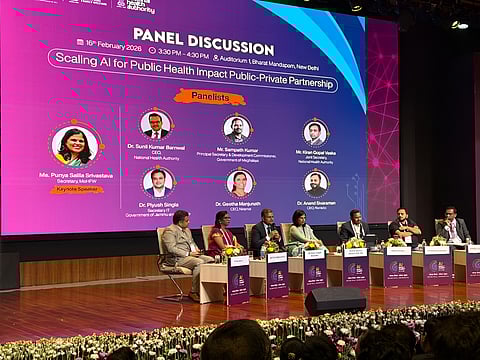

Union Ministry of Health and Family Welfare today hosted a high-level panel discussion on the theme “Scaling AI for Public Health Impact: Public-Private Partnership” as part of the India AI Impact Summit 2026 at Bharat Mandapam.
The Government of India is hosting the India AI Impact Summit 2026 from 16th to 20th February 2026 at Bharat Mandapam, New Delhi, marking the first-ever global AI summit to be held in the Global South. The Summit brings together global leaders, policymakers, industry experts, academia, and innovators to deliberate on the transformative potential of Artificial Intelligence (AI) across sectors, with a special emphasis on inclusive and sustainable development.
As a key participating Ministry, Ministry of Health and Family Welfare is playing a significant role in the Summit through a high-level panel discussion, the launch of key initiatives, and the showcasing of AI-driven healthcare solutions at its dedicated exhibition stall.
Delivering the keynote address, Union Health Secretary Smt. Punya Salila Srivastava stated that over the past decade, India’s health system has transitioned from basic digitisation of records and improved data reporting to building a nationally interoperable digital health ecosystem. She recalled that the National Health Policy set the vision of achieving the highest attainable standard of health and well-being for all citizens, which was further operationalised through the National Digital Health Blueprint by promoting open standards, interoperability, privacy-by-design, and the adoption of emerging technologies including Generative AI.
She highlighted that the Ayushman Bharat Digital Mission (ABDM) has evolved into a robust digital public infrastructure for health, with over 859 million ABHA accounts linked to more than 878 million health records. With more than 1.80 lakh Ayushman Arogya Mandirs operational across the country, digital platforms are being integrated at the primary care level. E-Sanjeevani, powered by AI-assisted Clinical Decision Support Systems (CDSS), has enabled over 449 million teleconsultations through more than 2.2 lakh registered healthcare providers, making it the world’s largest telemedicine initiative in primary healthcare.
Emphasising that digital systems enabled the capture and transmission of information while AI enables its intelligent interpretation and action, she noted that AI has the potential to reduce the burden on the healthcare workforce while strengthening — not replacing — the physician–patient relationship. Citing examples, she referred to MadhuNetrAI for AI-based diabetic retinopathy screening, AI-enabled handheld X-rays and acoustic screening tools such as Cough Against TB (CA-TB) for tuberculosis detection, and AI-integrated surveillance systems for faster epidemic alerts. She also highlighted the establishment of Centres of Excellence for AI in healthcare at AIIMS Delhi, PGIMER Chandigarh, and AIIMS Rishikesh.
Stressing the importance of collaboration, the Union Health Secretary invited industry and State representatives to share their experiences on working with government systems, improving procurement and data frameworks, and identifying AI solutions most useful in field settings. She underscored that under the leadership of Hon’ble Prime Minister Narendra Modi, India’s emphasis on digital public infrastructure as a tool for inclusion and equity continues to guide its digital health and AI journey, aligned with the vision of Viksit Bharat @2047.
Addressing the gathering, Dr. Sunil Kumar Barnwal, CEO, National Health Authority, stated that Artificial Intelligence can significantly enhance efficiency in healthcare delivery and enable faster, data-driven decision-making, particularly in large-scale public health programmes. He emphasised that AI-powered analytics can strengthen beneficiary identification, streamline claims management, detect fraud, and monitor service utilisation, thereby improving transparency, accountability, and overall system performance.
He further underscored the importance of building interoperable digital platforms supported by strong data governance and privacy safeguards to ensure responsible deployment of AI solutions. Highlighting the scale and complexity of national health schemes, he noted that technology-driven innovations are essential to optimise resource allocation, improve targeting of services, and achieve better health outcomes across the country.
The panel brought together eminent representatives from government, industry, multilateral organizations, and the start-up ecosystem to deliberate on scaling AI innovations for public health impact. Discussions focused on leveraging AI for predictive analytics, early disease detection, telemedicine, health data management, and real-time monitoring of public health programmes.
The Ministry is also showcasing its digital health and AI initiatives at the India AI Impact Expo 2026 at Stall No. 1.63 and 1.64, Hall 1, Bharat Mandapam. These include an AI-powered Clinical Decision Support System (CDSS), which enables structured, multilingual symptom capture through a patient assistance form and supports accurate, confident, and data-driven clinical decision-making.
The showcase also features BODH (Benchmarking Open Data Platform for Health AI), developed by IIT Kanpur in collaboration with the National Health Authority, to enable the evaluation of AI models on diverse real-world datasets prior to population-scale deployment, thereby promoting trustworthy and responsible innovation in health AI. The platform will be formally launched tomorrow, on 17th February, by Union Health Minister Shri Jagat Prakash Nadda.
Other initiatives on display include a Voice-to-Text AI model that converts a doctor’s voice into a digital prescription, seamlessly integrated into the existing HMIS workflow, and an AI-powered media surveillance system designed to generate early warning signals for disease outbreaks.
The India AI Impact Summit 2026 is expected to serve as a catalyst for collaborative action and knowledge exchange, enabling cross-sectoral partnerships to harness AI for public good. Through its active engagement in the Summit, the Ministry of Health and Family Welfare reiterates its commitment to leveraging cutting-edge technologies to strengthen public health systems and ensure accessible, affordable, and quality healthcare for all.
