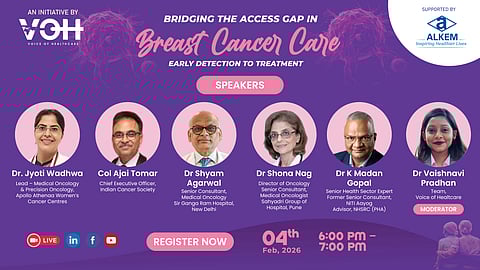

On the occasion of World Cancer Day 2026, a discussion titled “Bridging the Access Gap in Breast Cancer Care – Early Detection to Treatment” brought together leading clinicians, public health experts, and civil society voices to address one of India’s most pressing healthcare challenges—ensuring timely, equitable, and comprehensive breast cancer care for all women.
Moderated by Dr. Vaishnavi Pradhan from Team Voice of Healthcare (VOH), the discussion focused on the entire continuum of care—from awareness and screening to diagnosis, treatment, and follow-up—highlighting the gaps that continue to affect outcomes, especially for women in underserved regions.
Setting the context, Dr. Jyoti Wadhwa, Lead – Medical Oncology & Precision Oncology, Apollo Athenaa Women’s Cancer Centres said, “Breast cancer is now the most common cancer affecting women in India. As you rightly mentioned earlier, it overtook cervical cancer several years ago. If we look at the latest GLOBOCAN 2022 data, breast cancer alone accounts for nearly 27 percent of all cancers among Indian women.
What is even more concerning is that the numbers continue to rise every year. In 2022, we saw close to 1.9 lakh new breast cancer cases in India, and this figure is steadily increasing.
Another major challenge in our country is late diagnosis. Even today, nearly 60 to 70 percent of breast cancer patients in India present to us at advanced stages—stage three or stage four. This is largely due to low awareness levels and the absence of a structured, nationwide mass screening programme.
When we look at the biology of breast cancer in India, we also see certain distinct patterns. Based on hormone receptor and HER2 testing, breast cancer can be divided into different subtypes. One of these is triple-negative breast cancer, which is the most aggressive form. In India, we see a significantly higher proportion of triple-negative breast cancer compared to Western countries. These are some of the unique challenges we face while treating Indian women with breast cancer.
Coming to precision oncology, this is an important and evolving area in cancer care. Precision oncology, which is part of precision medicine, focuses on tailoring treatment to improve outcomes. In fact, it’s not entirely new—hormone therapy for hormone receptor–positive breast cancer is one of the earliest examples of precision oncology. However, over the years, this approach has become far more refined, and its scope has expanded significantly, leading to better patient outcomes.
That said, even in 2026, the real-world application of precision oncology in India remains limited. High costs and restricted access continue to be major barriers. Bridging this gap—between scientific advancement and patient access—remains one of the biggest unmet needs in breast cancer care in India today.”
Col Ajai Tomar Chief Executive Officer, Indian Cancer Society, stated, “What we’ve seen is that women in rural areas, unorganised settlements, and even semi-urban regions often do not visit fixed government health facilities like PHCs or hospitals. Distance is one reason, but fear is another. Many women are hesitant to step out of their comfort zones or travel far for screening.
This is where NGOs like the Indian Cancer Society step in. We take healthcare to the people instead of expecting people to come to healthcare. Our teams—doctors, paramedics, and trained volunteers—travel in specially equipped mobile vans that have mammography units, X-ray facilities, and blood testing equipment. We go directly to their doorsteps.
Before any screening begins, we conduct intensive awareness campaigns in the community. We work closely with ASHA workers and Anganwadi networks, distribute informational material, and use digital tools like our mobile app to educate women about common cancers, especially breast, cervical, and lung cancer. This helps build trust and reduces fear.
We also empower women by teaching them self-breast examination and providing simple training and educational material. Only after this groundwork is done do we bring in our mobile screening units. Unlike fixed government facilities, our approach is mobile and community-based.
All screening services—including mammograms—are provided free of cost, so financial constraints are removed. If any abnormality is detected, we don’t stop at screening. We offer diagnostic services free of cost as well and guide patients through the next steps.
Screening alone is not enough. What truly makes a difference is a complete continuum of care. We handhold patients from screening to diagnosis and ensure they reach the appropriate tertiary care centre for treatment. This end-to-end support is how we are able to make cancer care accessible for women who would otherwise remain outside the healthcare system.”
Dr Shyam Aggarwal, Senior Consultant – Medical Oncology, Sir Ganga Ram Hospital, New Delhi, emphasised, “Early diagnosis of breast cancer depends heavily on regular screening. Ideally, women should undergo a mammogram every year, or at least once every two years, after the age of 45. Unfortunately, in India, barely two percent of women follow this practice—and that too largely in metro cities.
This is in sharp contrast to countries like the US, where 70 to 80 percent of women undergo regular mammography, and Europe, where the figure is around 60 to 70 percent. This gap is enormous and needs urgent attention. We need to actively encourage women to come forward for periodic mammograms, in line with both national and international guidelines.
Another major barrier is that breast cancer often begins as a painless lump. Many women tend to ignore it, either intentionally or unintentionally. There is also a deep fear associated with the diagnosis itself—the belief that cancer automatically means surgery. The fear of losing a breast or undergoing an operation discourages many women from seeking medical advice, whether from a gynaecologist or a local surgeon.
Even when women do consult a doctor and undergo a mammogram, ultrasound, or physical examination, the moment a biopsy is advised, fear once again becomes a major hurdle. Anxiety around the procedure and the diagnosis often leads to delays, further pushing detection to later stages.”
Dr Shona Nag "Director of Oncology, Senior Consultant – Medical Oncologist, Sahyadri Group of Hospital, Pune, stated, “ Our population is simply too large to support mass mammography as a screening strategy. Mammography, and to some extent MRI, remain the most accurate tools for early breast cancer detection, but they come with significant challenges.
The high cost, shortage of trained radiologists, and the fear associated with a breast cancer diagnosis make mammography difficult to implement at scale. It’s expensive, labour-intensive, and not feasible across the country. Other approaches like thermography have been explored, but in a hot country like India, maintaining the required temperature contrast is extremely challenging, limiting its effectiveness.
The government has also introduced handheld devices like iBreast, which use sensor-based technology to detect abnormalities. However, inconsistent operator training often leads to false positives and false negatives. This makes large-scale screening difficult.
Given these realities, the most practical approach for India is awareness and early detection through simpler methods. Encouraging self-breast examinations from a young age helps women understand what is normal for them and recognize changes early. Annual clinical breast examinations by a healthcare professional are also extremely valuable, especially where access to specialists is limited.
There is evidence to support this approach. A study conducted in the slums of Mumbai showed that regular clinical breast exams reduced average tumour size at diagnosis from seven centimetres to four centimetres.
The way forward is decentralisation. We need to empower primary care doctors, general practitioners, and frontline health workers, including Anganwadi workers, to perform clinical breast examinations. Through training initiatives, we have seen that even years later, these workers continue to identify lumps and refer patients early. These small, practical steps can make a meaningful difference in breast cancer detection in India.”
Strengthening the public health system
Dr K Madan Gopal, "Senior Health Sector Expert, Former Senior Consultant, NITI Aayog
Advisor, NHSRC (PHA) said, “This is a very relevant question, because many people are not fully aware of the efforts the Government of India has made to address breast cancer care. India has a tiered public health system that is designed to support population-based screening, referral, diagnosis, and treatment.
At the foundation of this system is population-based screening carried out through primary healthcare facilities. We have nearly 1.82 lakh Health and Wellness Centres—also known as Ayushman Arogya Mandirs—across the country. At these centres, trained nurses and healthcare staff conduct initial screening using standard checklists and protocols.
To strengthen this effort, we have more than one million ASHA workers who support community-level screening and awareness. Once a woman is screened, there is a structured referral mechanism in place. Community Health Officers can use telemedicine platforms such as eSanjeevani to consult specialists and ensure timely referrals. While I’m not claiming this system works perfectly everywhere, the structure does exist, and we’ve already seen over 30 crore teleconsultations through this platform.
That said, screening—particularly for breast cancer—still remains a major challenge, and uptake is lower than it should be. On the treatment side, however, financial protection mechanisms are in place. Schemes like PM-JAY provide coverage for cancer treatment, and India was among the first countries to launch a dedicated National Programme for Non-Communicable Diseases.
This programme focuses on awareness, risk assessment, early identification, and clinical breast examination, while also strengthening secondary-level care. Many states have linked their screening programmes with tertiary institutions and medical colleges, ensuring that patients who are screened can be referred seamlessly for diagnosis and treatment.
In last year’s budget, the government also announced the establishment of day-care cancer centres at district hospitals. With over 780 districts in the country, these centres are expected to play a crucial role in delivering chemotherapy and follow-up care closer to patients’ homes, ensuring continuity of care.
At the secondary level, community health centres and sub-district hospitals are now being strengthened to confirm diagnoses. Updated guidelines and national diagnostic lists ensure that essential tests and markers are available across public health institutions.
At the tertiary level, medical colleges and major hospitals provide definitive cancer care, including surgery, chemotherapy, radiotherapy, and multidisciplinary management. Financial support from both central and state schemes, along with low-cost public services, helps improve affordability and access.
Finally, we also recognise the growing role of partnerships. The focus today is not just on public-private partnerships, but on partnerships for provisioning care. Collaboration across sectors will be essential to strengthen India’s cancer care ecosystem and ensure that no patient is left behind.”
As the World Cancer Day 2026 discussion made clear, bridging the access gap is not just a medical challenge, but a systemic and societal one. Ensuring that no woman is left behind will require sustained collaboration across government, healthcare providers, NGOs, and communities—turning intent into action, and access into outcomes.
