
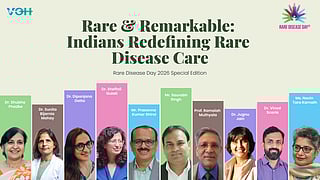
India’s rare disease landscape is being transformed by a community of extraordinary individuals whose commitment goes far beyond their professions. In this special Rare Disease Day 2026 edition, we spotlight the doctors, researchers, scientists, policymakers, NGO leaders, and innovators who are reshaping how rare diseases are understood, diagnosed, treated, and supported in the country.
These changemakers are not only advancing scientific discovery and clinical excellence—they are building systems of hope. From pioneering genomic solutions and establishing national registries to driving policy reform, empowering families, and expanding access to care, each of them is redefining what is possible for the rare disease community in India.
This feature celebrates their dedication, their vision, and their unwavering belief that every person with a rare disorder deserves timely diagnosis, compassionate care, and a future filled with dignity and possibility.

Dr. Shubha Rajendra Phadke is one of India’s most influential medical geneticists, whose three-decade career has profoundly shaped the country’s rare disease and clinical genetics ecosystem. As India’s first DM in Medical Genetics and former Professor & Head of the Department of Medical Genetics at SGPGIMS, Lucknow, she has played a transformative role in advancing dysmorphology, genetic hematology, and multidisciplinary rare disease care.
Her contributions extend far beyond clinical practice. She founded the Society for Indian Academy of Medical Genetics and has trained more than 46 DM specialists who now lead genetics programs across India. Since 2000, she has conducted the prestigious ICMR Course in Medical Genetics, mentoring over 600 clinicians in core principles of diagnosis, evaluation, and counselling.
A prolific researcher, Dr. Phadke has identified new malformation syndromes and rare disease genes, published more than 300 scientific papers, and authored the widely used textbook Genetics for Clinicians. In 2008, she launched Genetic Clinics, a quarterly open-access journal dedicated to spreading knowledge and creating awareness about rare diseases and medical genetics—an important resource for clinicians nationwide.
Highly respected nationally and internationally, she continues her work as Professor of Medical Genetics at Bharati Vidyapeeth Medical College, Pune, and Consultant at Jupiter Hospital. Her lifelong mission remains clear: strengthening rare disease diagnosis, education, and patient care across India.
Don't forget rare diseases...as eyes see what mind knows.
What mind does not know OMIM knows.
Correct diagnosis is the first step to help patients with rare diseases and their families.
Dr. Sunita Bijarnia Mahay is one of India’s leading clinical and metabolic geneticists, whose career has been deeply intertwined with the evolution of rare disease care in the country. She began her journey at a time when rare diseases were barely recognised and clinical genetics was an emerging discipline. After completing her paediatrics training, she joined Prof. I. C. Verma, regarded as the father of medical genetics in India, and received specialised training in genetic and metabolic disorders—conditions that make up nearly 80% of the rare disease spectrum.
In 2005, she played a key role in bringing families together to establish one of the earliest parent-led support societies for rare diseases in India, a group that has since become instrumental in awareness, advocacy, and patient support.
Following her fellowship in Sydney in 2010, Dr. Bijarnia Mahay returned to Sir Ganga Ram Hospital to strengthen clinical services for inborn errors of metabolism (IEMs). Recognising the urgent need for accessible dietary therapies, she worked closely with parent groups, clinicians, and policymakers to advocate for the availability of Foods for Special Medical Purposes (FSMPs). Her efforts contributed significantly to the FSSAI’s approval of imported and domestically produced FSMPs, enabling more children to receive appropriate nutritional and metabolic care.
She has been associated with the Indian Society for Inborn Errors of Metabolism (ISIEM) since its inception in 2005, later becoming its Secretary after formal registration in 2012. Her contributions also extended to national policy development, serving as one of the experts involved in shaping the Government of India’s National Policy for Rare Diseases.
Over the past two decades, Dr. Bijarnia Mahay has managed close to 1,000 children with metabolic disorders, with more than 150 currently under her care. She continues to prioritise prevention through prenatal diagnosis and carrier testing, ensuring families have access to informed reproductive choices. Her work has been central to building India’s clinical genetics ecosystem and expanding care pathways for children living with rare diseases.
Today, I see an evolved and evolving picture where there is awareness and treatment opportunities for our patients .
Dr. Dipanjana Datta is a molecular biologist and genetic counsellor with a PhD in Human Genetics and advanced training in neuromuscular and rare genetic disorders. Guided by a strong commitment to equity in healthcare, her work centers on translating genomic science into accessible, ethical, and patient-centred rare disease care in India.
She has played a key role in establishing Rare Disease Screening and Counselling Clinics within the public health system, including one of the earliest initiatives in eastern India. Her efforts have helped create pathways for early diagnosis, structured genetic counselling, and informed decision-making for families navigating complex and often life-limiting conditions.
As State Coordinator for West Bengal and the Northeast with the Organization for Rare Diseases India (ORDI), and as Scientific Advisor to Rare Warriors of Bengal, Dr. Datta actively collaborates with clinicians, diagnostic laboratories, policymakers, and patient communities to strengthen the rare disease ecosystem.
Her passion lies in counselling-led care—addressing not only medical needs but also psychosocial impact, ethical challenges, recurrence risks, and long-term family support. Through clinical work, training programs, advocacy, and research, Dr. Datta continues to work toward building sustainable, inclusive, and compassionate rare disease services across India.
“Awareness and diagnosis have laid the foundation for rare disease care in India. What we now urgently need is equal emphasis on cost-effective, accessible interventions—so that families are supported rather than overwhelmed, and care systems become socially inclusive, financially equitable, and centred on people, not just conditions.”
Professor Sheffali Gulati, a leading pediatric neurologist at AIIMS New Delhi, has been a driving force in strengthening India’s rare disease landscape through clinical excellence, research innovation, and policy engagement. At the All India Institute of Medical Sciences, she has championed integrated care models that bridge early diagnosis, multidisciplinary management, and translational science—particularly for children with Spinal Muscular Atrophy, Duchenne Muscular Dystrophy, rare epilepsies, autism-related syndromes, and other inherited neuromuscular disorders.
A trusted advisor to national stakeholders, Professor Gulati serves on multiple Government Committees and has contributed to frameworks for diagnosis, certification, and equitable access to emerging therapies. Her close collaborations with the Indian Council of Medical Research and international partners have strengthened national registries, advanced multicentric studies, and supported the development of India-specific evidence to guide rare disease care and policy.
Her work is deeply rooted in scalability and equity—ranging from culturally validated diagnostic tools to technology-enabled screening and nationwide capacity building for clinicians. Professor Gulati’s enduring mission remains clear: ensuring that every child with a rare neurological disorder is identified early and receives timely, evidence-based, and compassionate care.
Every child with a rare neurological disorder deserves early identification, timely intervention, and compassionate care. Our greatest responsibility is to ensure that science, systems, and society come together so that no child is left undiagnosed or unsupported.”
Prasanna Kumar Shirol has been a rare disease advocate since 2007, the year his daughter Nidhi was finally diagnosed with Pompe disease—becoming India’s first confirmed Pompe patient. Her diagnostic odyssey began at six months of age, and for nearly seven years the family travelled across hospitals searching for answers before receiving confirmation. That moment marked the beginning of his parallel journey in advocacy, evolving alongside Nidhi’s own medical battle.
Nidhi lived with courage for 24 years. She was on ventilator support for 17 years yet continued attending school and college with remarkable determination. A ventilator battery discharge in college led to cardiac arrest and hypoxic brain injury, after which she lived in a semi-coma state for six years. Her resilience became a powerful symbol for India’s rare disease community.
Prasanna co-founded ORDI, representing 7,000+ rare diseases, and previously co-founded the Lysosomal Storage Disorders Support Society — India’s first national rare disease parent group. He initiated India’s first Rare Disease Day in 2010 and led pioneering efforts including the national Rare Disease Helpline, the Rare Disease Care Coordination Centre, disease-specific clinics, and the “Race for 7” awareness run.
An Ashoka Fellow (2017) and Rare Champion of Hope Awardee (2019), he has contributed to shaping India’s rare disease policy and supported India’s endorsement of the Rare Diseases Resolution at the World Health Assembly. Through ORDI, he continues to champion early diagnosis, equitable access to treatment, and dignity for patients — while pursuing his dream project, “Who After Me.”
“India has taken key steps on rare diseases, yet lifelong care remains unmet. Strengthening early diagnosis, treatment access, supportive care, and affordable drug development is essential. No family should struggle alone—this is about equity and dignity.”
Saurabh Singh’s journey into rare disease advocacy did not begin in a medical school or a law classroom—it began in a hospital room filled with unanswered questions. Like many parents, he noticed subtle signs in his child and was reassured that “everything is normal,” yet his instinct knew otherwise. What followed was a long, painful search for answers, moving from doctor to doctor, test to test, and city to city. Years of uncertainty finally ended with a diagnosis, bringing both relief and fear: relief in finally knowing the name, and fear of an unknown future.
For Saurabh, rare disease was not just a medical condition—it reshaped his family’s entire life. Every hospital visit became hope; every report, fear. He witnessed firsthand that families are not only battling the disease, but also delays, lack of awareness, unaffordable treatment, no insurance support, weak policy systems, and often social misunderstanding.
After losing his son to Hunter Syndrome (MPS II), Saurabh transformed his grief into purpose. He left his MNC career, studied law, and became an advocate to support families like his own. Through the Rare Diseases India Foundation (RDIF), he channels compassion into action—strengthening patient advocacy, early diagnosis, treatment access, awareness, and emotional support—so that no rare disease family in India feels invisible or alone.
Rare diseases may be rare, but the pain is real and the responsibility is collective —strengthening care through a robust national policy is essential to respect our Constitutional Fundamental Right under Article 21 and ensure every patient in India lives with dignity
Prof. Ramaiah Muthyala, CEO & President of IORD, has built his journey in the rare disease space around a clear and unwavering vision: creating an equitable, structured, and patient-centered ecosystem for India. His work has consistently focused on ensuring that the voices of patients and families are not only heard but meaningfully integrated into national policy, research frameworks, and healthcare planning.
Since 2005, Prof. Muthyala has been deeply engaged in policy development, contributing to discussions on implementing and strengthening the National Policy for Rare Diseases. His key priorities include promoting early and accurate diagnosis, improving access to genetic services, encouraging the development of robust patient registries, and advancing sustainable financing mechanisms for long-term care.
A strong advocate for collaboration, he has played a pivotal role in bridging gaps between patient organizations, clinicians, researchers, industry stakeholders, and global rare disease networks. His representation of India in international forums has helped highlight both the country’s challenges and its emerging innovations in rare disease care.
Prof. Muthyala firmly believes that rare diseases must move from the margins to the mainstream of public health policy. His ongoing commitment is to shape inclusive frameworks that ensure dignity, affordability, and an improved quality of life for every rare disease individual and family in India.
“Behind every rare disease statistic is a family seeking hope, dignity, and timely care. Our collective responsibility is to transform that hope into structured systems of support.”
Dr. Jugnu Jain, co-founder of Sapien Biosciences, believes curing diseases demands systems thinking, scientific rigor, and clinical data. During her tenure at Vertex Pharmaceuticals, she observed how progress in cystic fibrosis accelerated when drugs were evaluated using patient-derived tissues and functional assays. That experience underscored a defining principle: when drug development is anchored in real patient biology, breakthroughs can be made possible even in difficult, rare diseases. Inspired by this insight, Dr. Jain has focused on building the foundational biobank infrastructure India needs for human disease research. Sapien Biosciences integrates ethically sourced, high-quality patient tissues with deeply curated clinical and molecular data—enabling translational research, biomarker validation, natural history studies, and therapeutic screening grounded in real patient material.
In rare diseases, where every sample is precious and every insight matters, representation and collaboration are critical. Dr. Jain advocates for open, responsible global partnerships that ensure Indian patients are included in discovery and development pipelines. By strengthening India’s capacity to generate, curate, and share high-quality patient data and biospecimens including rare diseases, Sapien aspires to serve as a national platform that empowers clinically translatable research —not only for India, but for the global scientific community.
“Rare diseases demand more than awareness—they demand infrastructure and collaboration. When we build systems that allow therapies to be tested on real patient tissues, we reduce uncertainty and accelerate hope. India must be an active, global partner in this mission, because every delay has a human cost.”
Dr. Vinod Scaria, Chief Data Officer at Karkinos Healthcare, is a clinician-turned-computational biologist whose work has significantly transformed India’s rare disease genomics landscape. His journey began with a fundamental question: why do so many Indian families spend years—and often decades—searching for a diagnosis that never arrives? This question shaped more than a decade of his work at the CSIR-Institute of Genomics and Integrative Biology (CSIR-IGIB), where he sought to bring timely, accessible genomic solutions to rare disease patients.
In 2012, Dr. Scaria and his colleague, Dr. Sridhar Sivasubbu, co-founded GUaRDIAN — the Genomics for Understanding Rare Diseases: India Alliance Network. What started as a small initiative has evolved into one of India’s largest rare disease genomics collaborations, bringing together more than 300 clinicians and researchers across 70+ medical and research institutions. The network has facilitated genetic diagnoses for hundreds of families, discovered novel variants unique to the Indian population, and enabled affordable diagnostic pathways now used nationwide.
Today, at Karkinos Healthcare, Dr. Scaria continues to work alongside Dr. Sivasubbu to integrate large-scale genomic infrastructure built for oncology into rare and undiagnosed disease research. His mission remains clear: precision medicine must be inclusive, and no patient—rare, complex, or undiagnosed—should be left behind.
“When genomic science becomes accessible and affordable, it transforms rare disease care. Our goal is simple: shorten the diagnostic journey for every Indian family.”
Navin Tara Kamath’s journey into rare disease advocacy began with her son, Taran—a young boy whose spirit of resilience shaped her mission. At just two years old, Taran’s unusually enlarged abdomen set off a year-long medical search marked by repeated tests and unanswered questions. After twelve months, the family received a life-altering diagnosis: Niemann-Pick Disease Type B (ASMD), an ultra-rare genetic condition affecting multiple organs. The diagnosis brought clarity but also overwhelming fear, especially with no treatment available for 13 years.
In 2022, Taran developed severe respiratory complications and was discharged on continuous oxygen support, leaving the family in constant fear. Everything changed with the arrival of Enzyme Replacement Therapy (ERT)—an intervention they describe as a miracle. Three years into ERT, Taran’s transformation has been remarkable: he no longer needs oxygen, his abdomen has normalized, and his energy and joy have returned. His family lovingly calls him “Taran 2.0.”
Yet Tara’s happiness is tempered by the reality that this life-saving therapy remains inaccessible for most families in India due to cost. This inequity, coupled with the lack of approved treatment for Niemann-Pick Type C, propelled her into patient advocacy. Through Niemann-Pick India, she has built supportive platforms for families to access information, navigate care, and push for policy reform.
For her, advocacy is essential—to enable early diagnosis, treatment access, prevention, and research—so every child with a rare disease has a fighting chance. Until then, her commitment, like Taran’s spirit, will never give up.
“Every rare disease child deserves a fighting chance. Treatment should not be a privilege—it is a lifeline. Until every family in India has access to timely diagnosis and care, our fight will continue with the same spirit that kept Taran going.”
Disclaimer:
“Rare & Remarkable: Indians Redefining Rare Disease Care” is a curated editorial feature developed exclusively for awareness and informational purposes. It does not represent an endorsement, ranking, or certification by Voice of Healthcare.
We recognize that many other clinicians, researchers, advocates, policymakers, and organisations across India are also doing remarkable work and making vital contributions in the fight against rare diseases.