
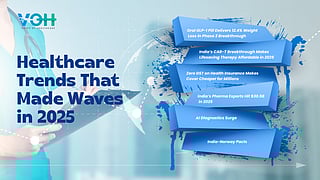
From breakthrough obesity drugs to AI-driven diagnostics and game-changing insurance reforms, 2025 proved to be one of the most transformative years for healthcare. Innovation accelerated across every layer of the ecosystem—drug development, digital health, robotics, regulation, preventive care, and global collaborations. India, in particular, emerged as a powerhouse with indigenous CAR-T therapy, nationwide digital health integration, and policy decisions that expanded access for millions.
This listicle breaks down the biggest healthcare trends that shaped 2025—those that redefined care delivery, expanded access to affordability, and laid the foundation for a tech-enabled, patient-centric future.

An experimental oral GLP-1 receptor agonist achieved a groundbreaking 12.4% average weight loss (27.3 pounds) at the highest dose in the phase 3 Attain-1 trial over 72 weeks, outperforming placebo by a wide margin. This needle-free pill, tested in adults with obesity or overweight plus comorbidities like hypertension, marked a pivotal shift from injectables like Zepbound, with 59.6% of high-dose participants losing at least 10% body weight and 39.6% hitting 15%.
Unlike prior orals limited by food restrictions, orforglipron allowed normal eating, boosting adherence despite a 21.9% discontinuation rate comparable to placebo.
Analysts note its efficacy rivals GLP-1 monotherapy benchmarks, though below injectables' 20% losses, promising broader access amid payer hesitancy on
high-cost shots. Real-world uptake will test tolerability against gastrointestinal side effects, but orforglipron heralds convenient, transformative obesity care.
India's CAR-T therapy advanced dramatically in 2025 with NexCAR19 (IIT Bombay-Tata Memorial) and Qartemi approvals for B-cell blood cancers, slashing
costs to $50,000 versus $400,000 abroad. Homegrown NexCAR19 treated refractory lymphomas successfully at top centers like Tata Memorial, marking Asia's first indigenously developed therapy. Over 100 patients accessed it via clinical expansions, boosting survival rates to 60-80% in relapsed cases.
Government backing via ICMR is aligned with public health research, reducing import reliance. Challenges like manufacturing scale persist, but partnerships with global firms have enhanced quality. This progress democratizes precision oncology, fitting precision medicine trends for rare diseases. CAR-T's affordability positions India as a hub, transforming blood cancer outcomes.
The GST Council's September 22, 2025, decision exempted all health insurance policies from 18% GST, retroactively lowering premiums by up to 15% for millions.
This reform, effective immediately, targeted family floaters and seniors, saving Rs 5,000-10,000 annually per policy amid rising claims.
Aligned with IRDAI pushes, it addressed affordability post-pandemic, where 55% lacked coverage. Critics praised equity gains for rural buyers, though implementation monitoring continues. The move catalyzed preventive care uptake, tying into diagnostics booms. Zero GST reshapes insurance as an accessible pillar of India's health ecosystem.
IRDAI's 2025 guidelines revolutionized access by removing senior age caps (previously 65), slashing pre-existing disease waits to 1-2 years, and halving moratorium periods to 5 years. These changes covered 500 million lives, enabling cashless everywhere and mental health inclusions.
Shorter PED waits from 4 years boosted chronic care, complementing Ayushman expansions. Compliance deadlines by Q4 ensured seamless rollout. Updates foster equity, aligning with GST relief for holistic coverage growth.
AI-driven robotics surged in India, with Vattikuti Foundation training 500 surgeons on systems like da Vinci, targeting a $20B global minimally invasive market by 2030.
Deployments cut procedure times by 30%, and recovery by 50% for urology and gynecology. Digital twins integrated real-time planning, reducing errors by 40%. Aligned with 5G, it enables remote ops amid surgeon shortages. Robotics transforms precision surgery, boosting outcomes in tier-2 cities.
Qure.ai's partnership with Microsoft in 2025 integrated its end-to-end lung cancer detection suite into the Precision Imaging Network, accelerating deployments across
U.S. hospitals and health systems for faster triage and management. Built on Large Language Models and Agentic AI, tools like qXR-LN detect nodules on chest X-rays, qCT-LN Quant measures CT findings, and qTrack coordinates care from radiologists to surgeons, addressing lung cancer's status as the top U.S. killer, surpassing breast, colon, and prostate combined.
Powering the ₹1 lakh crore preventive diagnostics market—with home tests, wearables—the boom reflects 22% CAGR driven by lifestyle burdens on 101 million diabetics. Qure.ai's Indian patents for lung abnormality tracking further embed AI in local workflows, enhancing equity via scalable, self-evolving models linked to EHRs. This convergence transforms detection speed, accuracy, and access, positioning AI as healthcare's frontline warrior against high-burden diseases.
India's pharmaceutical exports soared to $30.5 billion in FY2025, a 9.3% rise from the prior year, propelled by Contract Research, Development, and Manufacturing Organizations (CRDMOs) and Global Capability Centers (GCCs) amid global supply chain shifts. The U.S. absorbed over 32-40% of shipments, primarily complex generics and biologics, with formulations/biologicals dominating 75.74% of the
$4.96 billion May exports alone—up 7.38% YoY. Vaccines surged 13.64% to $190 million, while bulk drugs and intermediates grew 4.4%, underscoring diversification into oncology, anti-diabetics, and CNS therapies.
Post-China API disruptions, self-reliance initiatives like PLI schemes boosted domestic production, sustaining 5 million jobs and mitigating 74% import dependence.
Ayushman Bharat Digital Mission (ABDM) solidified India's digital health infrastructure in 2025, digitizing over 78 crore Ayushman Bharat Health Accounts (ABHAs) and linking more than 55 crore health records by mid-year, covering 36 states and 786 districts, including rural areas. With 3.63 lakh health facilities registered on Health Facility Registry (HFR), 5.64 lakh professionals on Health Professional Registry (HPR), and 1.59 lakh facilities using ABDM-enabled software, the platform spans Electronic Medical Records (EMRs), Hospital Information Systems (HIS), and AI analytics for seamless interoperability.
Aligned with ICMR research standards, it empowers evidence-based care via multilingual, offline-assisted creation—49.15% ABHAs held by women—bridging urban-rural gaps.
India and Norway deepened healthcare ties in 2025 through high-level meetings and the Norway India Partnership Initiative (NIPI) Phase IV, with Union Health Minister
J.P. Nadda proposing MoUs for collaboration in health, medicine, drug regulation, digital health, and research during talks with Norwegian counterpart Jan Christian Vestre.Building on 20 years of NIPI—starting from 2006 MDG child mortality goals—the October review by Health Secretary Punya Salila Srivastava and AmbassadorMay-Elin Stener approved the 2025–26 work plan, scaling digital tools like IPHS-ODK Toolkit for facility assessments and Decision Support Systems at Ayushman Arogya Mandirs in Bihar, Odisha, Madhya Pradesh, Rajasthan, and Jammu & Kashmir.
India's preventive diagnostics sector exploded in 2025, racing toward a ₹1 lakh crore valuation within the broader ₹1.54 trillion diagnostic labs market (FY24), fueled by 16-18% CAGR for wellness segments outpacing the overall 11.7% industry growth to ₹2.98 trillion by FY30.
Home collection services are now offering GLP-1 monitoring for 1M+ users—captured urban demand, with organized players expanding tier-2/3 towns via 13-14% annual surges amid chronic disease burdens. Lifestyle shifts—sedentary urban habits driving 101 million diabetes cases and 77 million prediabetics—propelled screenings for cancer, cardiac risks, and wellness packages, boosted post-COVID awareness.
India's 5G rollout revolutionized remote healthcare in 2025, powering wearables, robotics, and real-time monitoring with ultra-low latency (<1ms) and high bandwidth, accelerating telemedicine adoption amid eSanjeevani's 14 crore consultations.
Deployments in smart ambulances—equipped with AI diagnostics and live-streamed vitals—enabled paramedics to consult specialists en route, slashing response times 50% in urban trials like Ericsson-BT collaborations adapted locally. Wearables transmitted heart rate, BP, and glucose data continuously to ABDM-linked ABHAs (78 crore+), reducing hospital readmissions 30% for 101 million diabetics.
Robotic surgeries gained precision via 5G, integrating with Vattikuti-trained systems for tier-2 remote ops, while AR-assisted procedures bridged urban-rural gaps. Market projections hit USD 3.69B in 2025 at 35.5% CAGR to $30.93B by 2032, driven by IoT sensors, edge computing, and cloud EHRs in intelligent hospitals. Government DoT spectrum auctions and PLI schemes expanded rural coverage, aligning with ABDM for secure DPDP-compliant data flows.
Disclaimer: “Healthcare Trends That Made Waves in 2025” is a curated editorial initiative by Voice of Healthcare, created purely for informational and awareness purposes. This feature does not represent endorsement, ranking, or certification of any individual or organization. We recognize that numerous other distinguished experts and institutions are equally contributing to advancements in oncology and cancer care. The inclusion or sequence of names in this list does not imply preference, hierarchy, or priority. Readers are encouraged to seek broader perspectives to gain a comprehensive view of the oncology landscape.