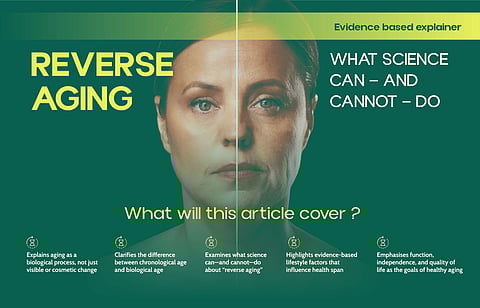

Aging is commonly discussed in terms of visible change—wrinkles, greying hair, or declining physical endurance. Scientifically, however, aging is not primarily cosmetic. It is a gradual biological process driven by molecular and cellular changes that influence organ function, disease risk, and physiological resilience over time.
As research on longevity advances, the idea of “reverse aging” has become more common in everyday conversation. While this reflects growing interest in living healthier for longer, the term can be misleading. Current science does not allow us to turn back the clock; instead, it shows that we can slow age-related decline and maintain function for longer—a distinction emphasised by researchers who focus on extending health span, not simply lifespan.
Aging is a biological process shaped by cellular changes—not merely a cosmetic one.
Biological aging does not result from a single mechanism. Instead, it reflects the cumulative impact of multiple, interconnected cellular processes unfolding across decades.
DNA damage accumulates with repeated cell division and environmental exposure. Mitochondrial efficiency declines, reducing cellular energy availability. Chronic low-grade inflammation increases with age, and senescent cells—cells that no longer divide but remain metabolically active—accumulate within tissues, impairing normal repair and regeneration. (López-Otín et al., Cell, 2013)
These biological changes often begin in early adulthood, long before visible signs of aging or chronic disease emerge.
DNA damage, mitochondrial decline, chronic inflammation, and cellular senescence together drive biological aging.

From a scientific standpoint, complete reversal of aging is not currently possible. Chronological age cannot be undone, and no validated intervention can comprehensively restore tissues or organs to a youthful baseline.
Research does, however, show that biological aging can be influenced. Improvements in metabolic health, reductions in chronic inflammation, and better cellular maintenance are associated with more favourable biological aging profiles. In practical terms, this reflects preservation of function rather than reversal of time. (Kennedy BK et al.,Cell, 2014)
Current science supports slowing and partially improving biological aging, not reversing time itself.
Chronological age measures the number of years lived. Biological age reflects how efficiently physiological systems are functioning relative to that timeline.
Advances such as DNA methylation–based “epigenetic clocks” demonstrate that individuals of the same chronological age can differ substantially in biological age (Horvath, Genome Biology, 2013).
Research shows that people of the same chronological age can differ substantially in biological age. These differences are seen across multiple domains, including metabolic health, cardiovascular function, muscle strength, cognitive performance, and motor function, and are influenced by factors such as physical activity, nutrition, sleep quality, stress exposure, and disease history (Belsky et al., PNAS, 2015).
People of the same chronological age can differ significantly in biological age based on lifestyle and health.
Among all interventions studied, lifestyle factors consistently demonstrate the strongest influence on biological aging.
Regular physical activity supports mitochondrial function, preserves muscle mass, and improves metabolic health. Evidence suggests that combining resistance training at least two days per week with 150–300 minutes of moderate-intensity aerobic activity weekly is associated with healthier aging outcomes. (Piercy et al., JAMA, 2018) Sedentary behaviour, even among individuals who exercise intermittently, has been linked to faster biological aging.
Dietary patterns also play a central role. Diets rich in whole foods and fibre are associated with lower inflammatory markers, while high intake of ultra-processed foods correlates with metabolic stress (Monteiro CA et al., BMJ, 2019). Chronic sleep restriction—particularly fewer than six hours per night—has been associated with hormonal imbalance, reduced insulin sensitivity, and impaired metabolic control. (Spiegel et al., The Lancet, 1999)
Stress management and preventive care further influence aging outcomes. Chronic psychological stress contributes to immune and metabolic dysregulation through sustained cortisol exposure and inflammatory pathways, while routine preventive health screening enables early identification and management of conditions that accelerate biological decline (Nature Reviews Endocrinology, 2018).
Combining resistance training (≥2 days/week) with 150–300 minutes of aerobic activity is consistently linked to healthier aging.
Supplements are frequently positioned as anti-aging solutions, yet their role remains limited. While correcting nutritional deficiencies such as vitamin D or iron can support overall health, supplementation alone does not reverse biological aging processes.
Current evidence supports a nutrition-first approach, with supplements used selectively and preferably under medical guidance.
Supplements support health when deficiencies exist but do not reverse biological aging.
Contemporary aging research increasingly prioritises health span—the years lived in good physical and cognitive health—over lifespan alone. Preserving mobility, metabolic stability, and cognitive function has a greater impact on quality of life than extending longevity without function.
By focusing on health span, aging becomes a process that can be managed and optimised rather than reversed.
Extending health span—years lived with function and independence—is the primary goal of aging science.
The concept of reverse aging captures public imagination, but scientific evidence supports a more measured interpretation. While aging cannot be undone, its biological impact can be meaningfully influenced through sustained, evidence-based interventions.
Healthy aging is best achieved through prevention, consistency, and preservation of function—not promises of reverse aging.