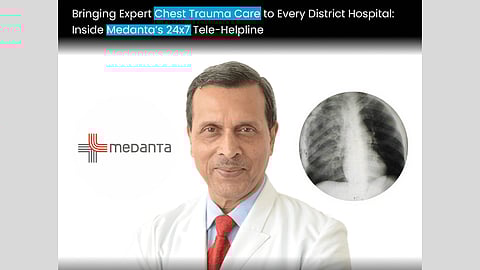

Chest trauma remains one of the most under-recognised medical emergencies in India, frequently complicated by delayed referrals, limited access to specialised expertise, and gaps in timely intervention—particularly outside major urban centres. Addressing this critical challenge, Medanta has launched a free, 24x7 tele-helpline for chest trauma patients, designed to provide real-time expert support to doctors across the country.
In a conversation with Mayank Badhwar, Senior Editor, Voice of Healthcare, Dr Arvind Kumar, Chairman, Institute of Chest Surgery at Medanta, outlined the thinking behind the initiative and its potential to transform emergency chest trauma care nationwide.
According to Dr Kumar, the initiative was driven by insights drawn from Medanta’s own patient data. “We observed that a large number of chest trauma patients were being referred to us very late. Many of the complications they presented with could have been avoided had they received appropriate care at the right time,” he said.
Chest trauma, he emphasised, requires swift and informed decision-making—something that is often constrained by the lack of trained thoracic specialists, especially at district and secondary healthcare facilities. With very few training centres for thoracic surgeons and a growing burden of trauma cases expected over the next decade, Dr Kumar noted that a decentralised care model was essential. “We needed a solution that could reach patients where they are, instead of expecting everyone to come to a tertiary hospital,” he explained.
The tele-helpline, which is entirely free of cost, is available round-the-clock. Doctors can seek expert advice at any time without worrying about payments. “Even if someone calls us at two in the morning, we will not ask for payment. This is a social service initiative,” Dr Kumar said, adding that it aligns with Medanta’s broader public health efforts under the Lung Care Foundation, including work on lung health and pollution awareness.
Technology plays a central role in the initiative. The helpline leverages video-based consultations, allowing treating doctors to share chest X-rays, CT scans, bronchoscopy images, and live assessments of a patient’s breathing. “Seeing the patient in person is ideal, but the next best thing is seeing them through live video. We learnt this during COVID, and it has given us confidence that telemedicine can significantly improve emergency care,” Dr Kumar noted.
A key pillar of the programme is capacity-building at district hospitals, particularly in performing essential life-saving procedures such as chest tube insertion. Conditions like air or blood in the chest, Dr Kumar explained, can often be effectively managed with this single intervention, accounting for nearly 85% of chest trauma cases.
“Unfortunately, many district hospitals either do not perform chest tube insertions or hesitate due to fear of complications,” he said. Through the tele-helpline and structured training programmes, Medanta aims to equip doctors with the skills and confidence needed to perform these procedures safely. “If this skill becomes universally available at district hospitals, it would be a major achievement for our healthcare system,” he added.
Ultimately, the initiative seeks to standardise chest trauma care across the country, reduce avoidable complications, and ensure timely referrals only when specialised intervention is required. “Our goal is simple—to ensure that every chest trauma patient in India receives world-class, best-possible care, irrespective of where they are treated,” Dr Kumar said.
Reinforcing the message to healthcare providers, he added, “If you have a chest trauma patient, we have a solution. Whether it’s a simple query or a complex case, we are here to support you. Together, we can save more lives by delivering the right care at the right time.”