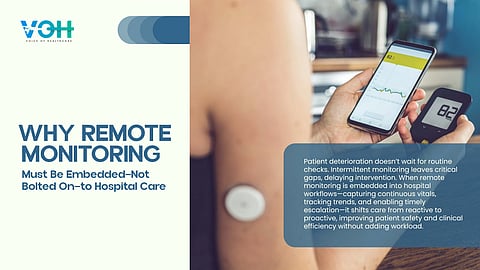

Hospitals today operate in an environment of rising patient acuity, workforce constraints, and increasing expectations for safety and efficiency. Yet inpatient monitoring in many settings still relies on intermittent vital sign checks, performed at fixed intervals and documented manually. Clinical deterioration, however, does not follow schedules. It often develops silently between observations, delaying intervention and escalation.
Remote monitoring offers a way to close this gap—but only if it is embedded into hospital patient management, rather than added as a standalone technology.
The Limits of Intermittent Monitoring
Traditional ward monitoring is episodic by design. Vital signs are captured every few hours, during rounds or shift changes, leaving long periods without clinical visibility. Early signs of sepsis, hypotension, arrhythmias, or respiratory decline may go unnoticed until the patient becomes overtly unstable.
Staffing pressures, documentation workload, and alarm fatigue further compound the problem. The result is a reactive care model, where response follows deterioration instead of preventing it.
What “Embedded” Remote Monitoring Means
Embedding remote monitoring is not about introducing more devices or dashboards. It is about integrating continuous patient data into everyday clinical workflows.
In an embedded model:
· Vital signs are captured frequently or continuously
· Trends and rate of change are prioritized over single readings
· Alerts follow defined clinical escalation pathways
· Monitoring data is visible within existing hospital systems
Remote monitoring becomes part of routine inpatient care—supporting, rather than competing with, clinical decision-making.
Remote Monitoring as Clinical Infrastructure
When embedded effectively, remote monitoring functions as clinical infrastructure, enabling proactive and standardized care.
Continuous Risk Surveillance
Key physiological parameters—such as blood pressure, heart rate, oxygen saturation, and respiratory rate—are tracked over time. Subtle but clinically significant trends can be detected hours before overt deterioration, allowing earlier intervention and reducing unplanned ICU transfers.
Protocol-Driven Escalation
Embedded systems generate alerts based on predefined thresholds and trend analysis. These alerts are routed through a tiered escalation model—first to bedside staff, then to treating physicians, and finally to rapid response teams if required. This ensures timely action without overwhelming clinicians with unnecessary notifications.
Smarter Use of Clinical Resources
By reducing manual measurements and documentation, remote monitoring allows nurses and doctors to focus on assessment, decision-making, and patient interaction. Clinical teams gain better visibility across wards, enabling prioritization of high-risk patients and more informed rounds.
Impact on Hospital Outcomes
When remote monitoring is woven into patient management pathways, it delivers measurable benefits. Early detection of deterioration improves patient safety and reduces adverse events. Operational efficiency improves through shorter lengths of stay and fewer emergency escalations. From a system perspective, this translates into lower costs associated with complications and readmissions, aligning closely with value-based care goals.
Why “Bolted-On” Monitoring Falls Short
Many remote monitoring initiatives fail not because of technology limitations, but because of poor integration. Standalone systems that operate outside clinical workflows often create parallel processes, unclear accountability, and alert fatigue. When clinicians perceive monitoring as extra work rather than clinical support, adoption remains low and impact is limited.
Technology adds value only when it fits naturally into how hospitals function.
Conclusion
Remote monitoring should no longer be viewed as an optional digital add-on or a pilot project confined to specific units. It is a foundational element of modern inpatient care—enabling continuous visibility, earlier intervention, and more efficient use of clinical research.