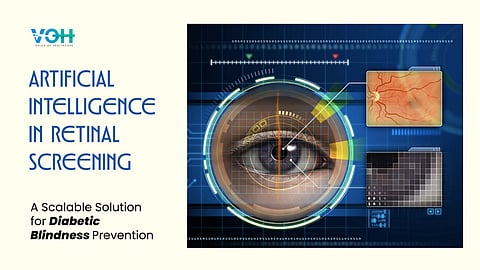

The global rise in diabetes has brought renewed urgency to detecting its most preventable complication: Diabetic retinopathy (DR). As one of the leading causes of vision loss among working-age adults, DR demands systematic screening. Yet in many regions, specialist shortages, geographic barriers, and limited infrastructure have made universal retinal screening difficult to achieve. Artificial intelligence (AI)–based eye scans are now emerging as a practical response to this gap.
AI screening systems analyse digital retinal photographs captured with fundus cameras and classify them according to disease severity. Trained on large annotated datasets, these algorithms detect lesions such as microaneurysms, hemorrhages, and exudates within seconds. Most platforms categorize images into non-referable and referable disease, enabling rapid triage. Their primary value lies not in replacing ophthalmologists, but in identifying which patients most urgently require one.
India’s recent entry into this space marks an important shift. In December 2025, a government-supported community screening programme using AI for diabetic retinopathy was launched through a collaboration involving the Armed Forces Medical Services, the All India Institute of Medical Sciences, and the Ministry of Health and Family Welfare. The programme deploys an AI platform capable of analysing retinal images captured by trained health workers in community settings. By design, it extends screening beyond tertiary hospitals into primary-level care environments and geographically diverse regions.
This transition from pilot research to structured public health implementation signals growing institutional confidence in AI-assisted screening. If scaled responsibly, such models could help bridge the gap between rising diabetes prevalence and limited specialist capacity, particularly in underserved populations.
The advantages are clear. AI systems offer high sensitivity for detecting referable disease, rapid analysis, and standardized grading unaffected by human fatigue or inter-observer variability. In mass screening scenarios, they can reduce specialist workload while ensuring that high-risk patients are prioritized for evaluation. Teleophthalmology networks further amplify this effect by linking remote screening sites with referral centers.
However, screening is not diagnosis. Algorithms interpret images, not patients. They cannot evaluate symptoms, systemic disease control, visual acuity, or coexisting ocular pathology. Nor can they independently determine management. Image quality, dataset bias, and variability across devices remain practical concerns. Systems optimized for sensitivity may increase false positives, potentially overburdening referral pathways.
The central question, therefore, is not whether AI should be used in retinal screening, but how it should be integrated. Used appropriately, it functions as a triage accelerator embedded within clinical oversight. Used indiscriminately, it risks creating algorithm-driven medicine detached from clinical judgment.
AI-based eye scans represent one of the most mature real-world applications of artificial intelligence in healthcare today. Their promise lies in expanding access and standardizing detection—not in substituting specialist care. The future of diabetic retinopathy prevention will likely depend on a collaborative model in which algorithms enhance clinical reach while physicians retain diagnostic authority.