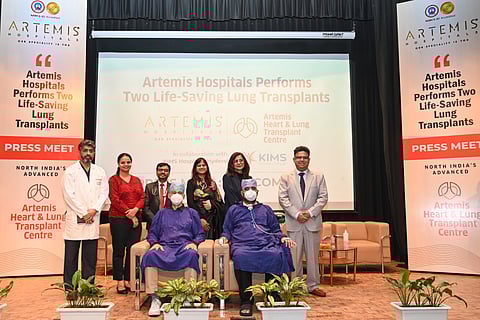

Artemis Hospitals has set a new standard in advanced healthcare by successfully completing two complicated lung transplants in a short period of time, saving the lives of both an international and a domestic patient. The accomplishment demonstrates the hospital's medical proficiency, the effective collaboration among various departments, and the transformative impact of organ donation on individual's lives. The objective of this program is to improve access to lung transplantation for patients in North India who previously had to travel to South India for treatment. By bringing advanced transplant services closer to home, the program reduces physical, emotional, and financial strain on patients and their families, while also contributing to the growth of medical value tourism.
“India is no longer just a destination for affordable care—it is fast emerging as a global hub for the most complex surgeries and organ transplants. When patients walk out breathing independently after heart and lung transplants, it reflects not just clinical excellence, but the growing maturity and confidence of India’s healthcare ecosystem,” said Dr. Devlina Chakravarty, Managing Director, Artemis Hospitals, in conversation with Mayank Badhwar, Senior Editor, Voice of Healthcare.
Mr. John Andrew Mollenthiel, a 54-year-old patient from Trinidad and Tobago, was one of the people who got the gift. He was sent to Artemis because his lung disease got worse quickly. He needed more oxygen, he was often sick and he had lost a lot of strength. His case was medically complicated because he had a lot of immune activity which made it more likely that his organs would be rejected. There were also strict rules about transplants for international patients.
The medical team worked hard for several weeks to get him ready for surgery using immune-modulating therapy and structured physiotherapy. When a suitable donor lung became available from Jalandhar, with a quick communication with national transplant authorities along with the help of Shinon Healthcare, team made sure it was sent and given to the right person on time. The organs got to Gurugram safely thanks to a green corridor and the transplant went well on December 3. Just a few weeks later, Mr. Mollenthiel can walk on his own, work out every day and feel more confident in his daily life.
The second transplant was for Mr. Pushpendra Kumar an IT executive from Uttar Pradesh who had advanced interstitial lung disease. His condition had made it very hard for him to breathe and made him mostly dependent on others for help. After moving to Artemis in September, the focus shifted to improving his physical abilities even though he had problems like being extremely obese and not being able to move around much.
Artemis Hospitals successfully arranged for an organ donation to take place in-house under the guidance of Dr. Saurabh Anand, Chief – Neuro-anaesthesia and Neurocritical Care in November. Mr. Pushpendra is breathing easily, doing his daily tasks on his own and getting stronger every day almost five weeks after his surgery.
The Team Involved in making the transplant successful were Dr. Sandeep G. Attawar (Program Director & Chair Thoracic Organ Transplantation & Assist Devices KIMS Hospitals, Hyderabad), Dr. Biswarup Purkayastha, (Consultant – Heart & Lung Transplant and Vascular Surgery Artemis Hospitals), Dr. Shweta Bansal, (Senior Consultant – Pulmonology, Artemis Hospitals), & Dr. Kuldeep Singh, (Chief-Critical Care -Heart and Lung Transplant, Artemis Hospitals).
The panel present at the event explained, “Lung transplantation can be life-saving for patients with end-stage lung disease. While it requires careful evaluation, a suitable donor and strong family support, the outcomes can be transformative. These two successful lung transplants have not only saved lives but restored the possibility of a meaningful, active future. Organ donation remains critical, as a single donor has the power to save multiple lives and leave a lasting impact on society.”
These two successful transplants send a strong message: with awareness, coordination and dedicated medical care even the hardest cases can become stories of hope and new beginnings.