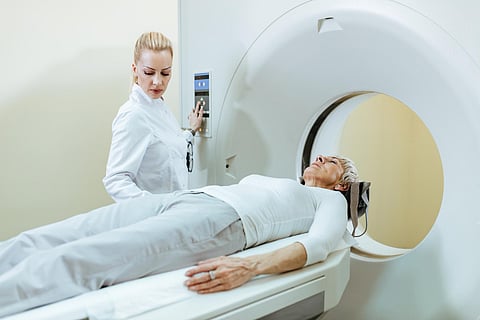

A pilot study by Karl Landsteiner University of Health Sciences (KL Krems) has found that head position during MRI scans of the brain and inner ear can significantly influence image interpretation and patient comfort. The research shows that certain dark, diamond-shaped areas seen in inner ear scans—previously suspected to indicate pathology—may actually be artifacts caused by how a patient’s head is positioned inside the scanner.
The study revealed that these so-called “flow void” artifacts become more pronounced when the head is tilted backward and less visible when the chin is tilted toward the chest. In some cases, participants also reported mild dizziness when their head was extended. The findings support the theory that strong magnetic fields in high-field MRI systems can trigger movement of inner ear fluids, affecting both imaging results and balance sensations.
High-field MRI scanners operating at 3 Tesla (3T) and above are widely used in neuroradiology. At these strengths, the static magnetic field can interact with tiny electrical currents in the inner ear fluids, generating Lorentz forces. These forces are known to cause nystagmus and vertigo in individuals with a healthy vestibular system. At the same time, MRI techniques used to visualise the inner ear are highly sensitive to even minimal fluid motion.
The research team, led by Prof. Dr. Domagoj Javor, Head of the Institute of Diagnostic and Interventional Radiology, and Dr. Béla Büki from the Division of Otorhinolaryngology at University Hospital Krems, examined 20 healthy adults without known vestibular disorders using a 3T MRI scanner. The study was designed as a proof-of-principle trial rather than a large-scale investigation.
Each participant underwent two high-resolution inner ear scans using a T2-weighted SPACE sequence—one with the head flexed (chin down) and one with the head extended (tilted back). Images were reconstructed along the horizontal semicircular canal, and two independent experts measured the proportion of the vestibule occupied by hypointense “flow void” areas.
Results showed that with the head tilted back, the low-signal area in the vestibule increased by around 15 percentage points on both sides compared to the chin-down position. Additionally, three of the 20 volunteers (approximately 15 per cent) reported mild vertigo in the extended position, while none experienced symptoms when their head was flexed.
From a physics standpoint, the findings align with current models of magnetic vestibular stimulation. When the head is extended, the direction of ionic currents in the inner ear becomes more perpendicular to the scanner’s magnetic field. This increases the Lorentz force acting on ions, driving stronger endolymph flow—particularly in the utricle and lateral semicircular canal. Such fluid motion can both stimulate balance structures, leading to dizziness, and disrupt MRI signals, creating more prominent flow artifacts.
For clinical practice, the researchers recommend a cautious and practical approach. If a suspicious hypointensity appears in the vestibule on T2-weighted imaging, radiologists should consider whether it changes with head position or across different MRI sequences before diagnosing a lesion. Comparing results with gradient-echo sequences, which are less sensitive to slow fluid motion, may help differentiate artifacts from genuine abnormalities. Documenting head position and reconstructing images in the plane of the horizontal semicircular canal can also improve left–right comparisons.
The authors emphasise the limitations of the study. It was conducted at a single centre, using one 3T scanner and a specific imaging protocol, with only 20 healthy volunteers. The range of head positions was limited by the head coil design, and neither eye movements nor inner ear fluid dynamics were directly measured. Larger studies across different field strengths and involving patients with vestibular disorders are needed to confirm the findings.
Despite these limitations, the study highlights the importance of interdisciplinary collaboration between radiology and otorhinolaryngology. The findings are already informing teaching, protocol development and patient management at KL Krems and University Hospital Krems, offering practical guidance on how to interpret inner ear MRI findings more accurately while enhancing patient comfort.
